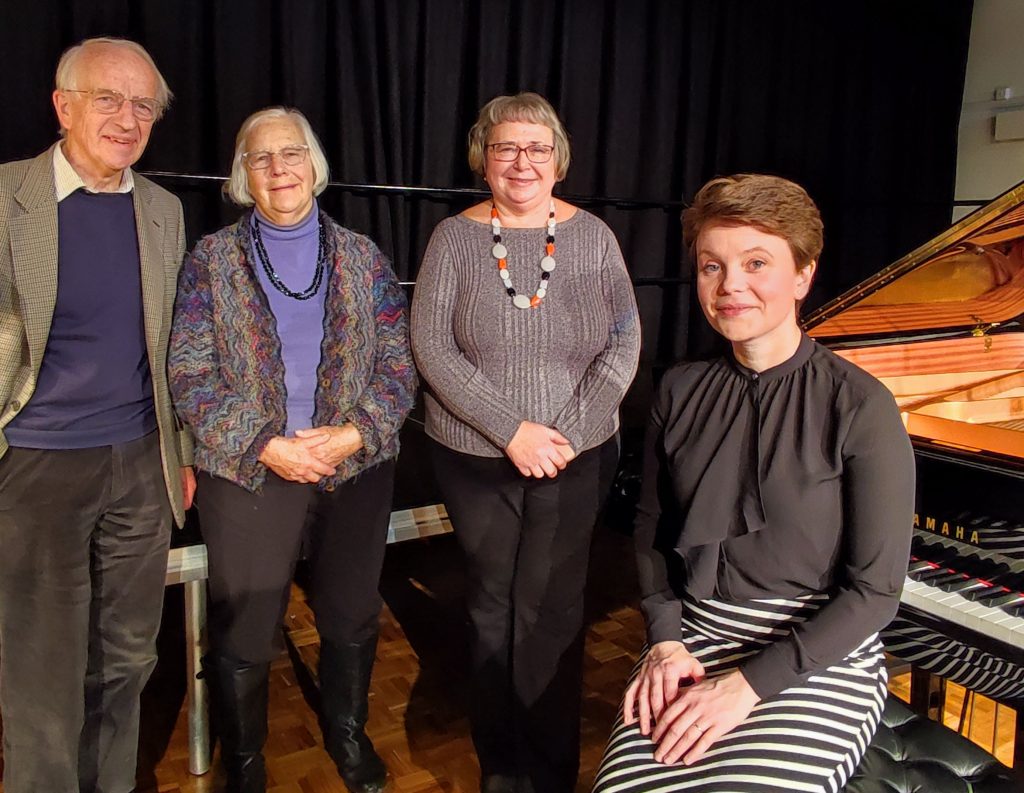
Clare Hammond after her performance for nadsa concerts
nadsa Concert Review – Clare Hammond
📍 The Courtenay Centre, Newton Abbot
🎹 Clare Hammond – piano
Programme
Mél Bonis – Femmes de Légende (selections)
Germaine Tailleferre – Partita
Maurice Ravel – Miroirs
Claude Debussy – Images, Book I
Co-created by participants at HMP Oakwood with Michael Betteridge – Internal Victories
Cécile Chaminade – Autrefois; Au pays dévasté
Maurice Ravel – Sonatine
Encore
Cécile Chaminade – Impromptu, Étude de concert, Op. 35 No. 5
Review
With Clare Hammond we had style, substance and soul. The style was almost entirely French, the composers were similarly of a restricted period – late romantic/impressionist – and the exquisite phrasing and dynamics must surely have touched our souls.
Clare introduced the audience to some welcome background information about Mel Bonis, a relatively unknown French composer. After hearing three of Mel’s ‘Femmes de Légende’, narratives in impressionist style, I have no doubt that had Mel Bonis been a man, the name would have been as familiar to us as her contemporaries Franck, Debussy and Ravel. She’s fascinating material for a drama/documentary or opera.
Our appetite for discovery was further whetted by Clare’s introduction to Germaine Tailleferre’s ‘Partita’. The composer’s life surely another candidate for a gripping opera. The Partita has three movements the first of which ‘Perpetuum mobile’ was light, mechanical and puppet-like; such a contrast to the previous impressionist pieces. Then followed ‘Notturno’ another contrast: dreamy legato, sometimes disturbingly unusual. The final movement was fast, light almost frenetic: how well chosen to demonstrate Clare’s stunning versatility.
Maurice Ravel’s Miroirs’ 5 movements were separately dedicated to the members of Les Apaches (hooligans), an artistic group formed with Ravel in the early 1900s. The movements are probably as dissimilar from each other as the people to whom they are dedicated. Of particular note was Clare’s rendering of ‘Une barque sur l’ocean’ where differing moods of the sea were depicted by impressionistic sparkles and swirls, threatening dramatic swells and reflective calm. The timbre of the following Spanish movement ‘Alborada del gracioso’ was completely different. Here we had virtuosity stamping on dry land. The bells of ‘La vallee des cloches’, the final movement, left our valley in whispered calm.
The opening piece after the interval was ‘Reflects dans l’eau’ the first of Debussy’s Images Book 1. Debussy could hardly have been surprised that this style of his, probably inspired by Monet’s water-lily ponds, was termed impressionist. One felt the ripples and shimmering light. The second from book 1, ‘Hommage a Rameau’, was a pensive romantic narrative: very different, and again the third, ‘Mouvement’ was contrastingly fast and intense, however, as previous movements, ended tranquilly.
And then Clare introduced us to something completely different: ‘Internal Victories’, a co-created work by participants at HMP Oakwood with composer Michael Betteridge and Clare Hammond. This took us out of France, into the 21st century and the environment of an English prison. Opening with the thud of a closing door, followed by the delicacy of keys and periods of pensive calm, this was a place of episodic drama. An alien environment for most of us – with gleams of hope for the co-creators.
Cécile Chaminade’s ‘Autrefois’ followed. What a juxtaposition. A simple melody, heavy with nostalgia, sandwiched a middle section that was, for me, alive with the freedom of swallows and swifts. Magical! Chaminade’s ‘Au pays devasté’ was written in 1918. A sombre work, the gravity of which persists.
The final programmed work, Ravel’s well-known ‘Sonatine’, developed from a restrained melodic first movement to a toccata of impressionist drama.
The audience was pleased to get an encore: Cécile Chaminade’s ‘Impromptu’ Etude de concert, Op. 35 No. 5. A relatively early work (1886), and a delightful spirit in which to send us home.
Clare Hammond has the knack of giving a sense of being to music. Her recital introduced us to three relatively neglected female French composers, all of whose biographies are worthy of an opera, and whose music should be more widely heard. There are very few other musicians I would entrust the HMP project to. Clare’s pianissimos were so exquisite that a quartz clock was removed from the auditorium; nothing, bar heartbeats, was allowed to spoil the music.
nadsa concerts, Sunday16th November 3.30pm at The Courtenay Centre, Newton Abbot.
JRC