

28 February 2027 @ 3:30 pm - 5:30 pm
£25.00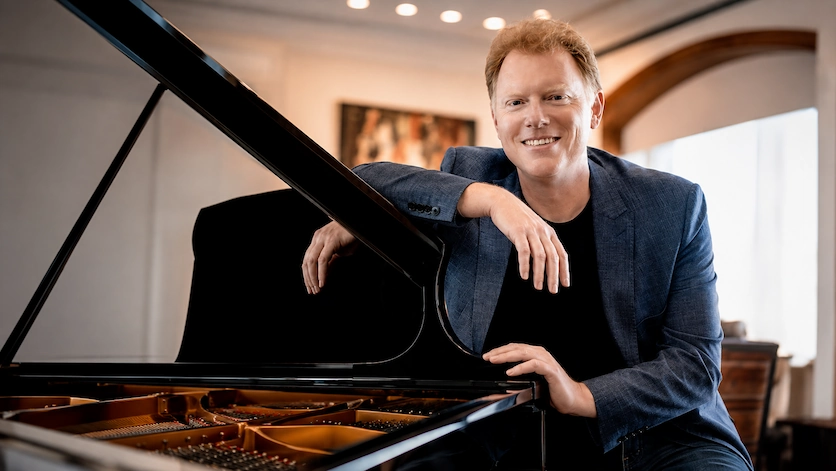
Artist: Tim Horton (piano)
Concert Sponsor: C & M Pike Trust
Programme
- Ludwig van Beethoven – Piano Sonata No. 9 in E major, Op. 14 No. 1
- Ludwig van Beethoven – Piano Sonata No. 10 in G major, Op. 14 No. 2
- Ludwig van Beethoven – Piano Sonata No. 8 in C minor, Op. 13, “Pathétique”
- Interval
- Franz Schubert – Four Impromptus, D 935 (Op. 142)
About the Concert
On Sunday 28 February, one of the United Kingdom’s leading pianists comes to nadsa. Tim Horton, a founding member of Ensemble 360 and a regular at major festivals across the country, presents an afternoon of Viennese masterworks: three contrasting Beethoven sonatas, culminating in the celebrated Pathétique, followed by Schubert’s four beautiful and finely crafted impromptus.. Reviewing his recent playing, The Strad praised its “brilliance, precision and tireless energy.” This is a programme of intimacy and grandeur from a pianist at the height of his powers.
From Beethoven’s Wit to Schubert’s Farewell
The recital opens with the two sonatas of Beethoven’s Op. 14, written in 1798–99. The Sonata No. 9 in E major is intimate and lyrical, so songlike that Beethoven later arranged it for string quartet; its companion, the Sonata No. 10 in G major, is light, witty and pastoral, full of playful invention. The first half closes with the Pathétique, completed in 1798, whose stormy C minor drama and famous singing Adagio made it one of the most celebrated works of his early maturity.
After the interval comes Schubert’s set of Four Impromptus, D 935, composed in December 1827 in the last full year of his life and published only after his death, in 1839, as Op. 142. Schumann thought the set was really a sonata in disguise, and the four pieces do form a satisfying whole, ranging from high drama to the most intimate songfulness. The first, in F minor, is the most expansive, unfolding on an almost orchestral scale and framing a glowing central episode in A flat major. The second, in A flat major, is a tender, minuet-like Allegretto of disarming simplicity, its serenity shadowed by a more restless central section. At the heart of the set stands the third, in B flat major, a sequence of graceful variations on a melody Schubert had already loved enough to use in his Rosamunde music, by turns delicate, brilliant and wistful. The finale, in F minor, is a sparkling, Hungarian-flavoured dance that gathers headlong momentum and drives the afternoon to an exhilarating close.
About the Artist
Tim Horton is equally at home in solo and chamber repertoire and is regularly invited to perform at major festivals and concert series across the country. Early in his career, on the recommendation of the late Alfred Brendel, he stood in at short notice to perform Schoenberg’s Piano Concerto at Symphony Hall, Birmingham and the Royal Festival Hall, London, with the City of Birmingham Symphony Orchestra under Sir Simon Rattle. In 2005 he was made a Scholar of the Klavier-Festival Ruhr, and he gave his debut solo recital at Wigmore Hall in 2016. A founding member of Ensemble 360 and the Leonore Piano Trio, he has recorded extensively for Hyperion and has performed complete cycles of the Beethoven and Schubert sonatas for Music in the Round in Sheffield.
Why You Shouldn’t Miss This
To hear a great pianist explore Beethoven and Schubert in a single afternoon is one of the deepest pleasures a recital can offer. With his combination of intellectual insight and expressive warmth, Tim Horton promises playing of real distinction. It will be a joy in nadsa’s intimate setting.